The 12% Reality
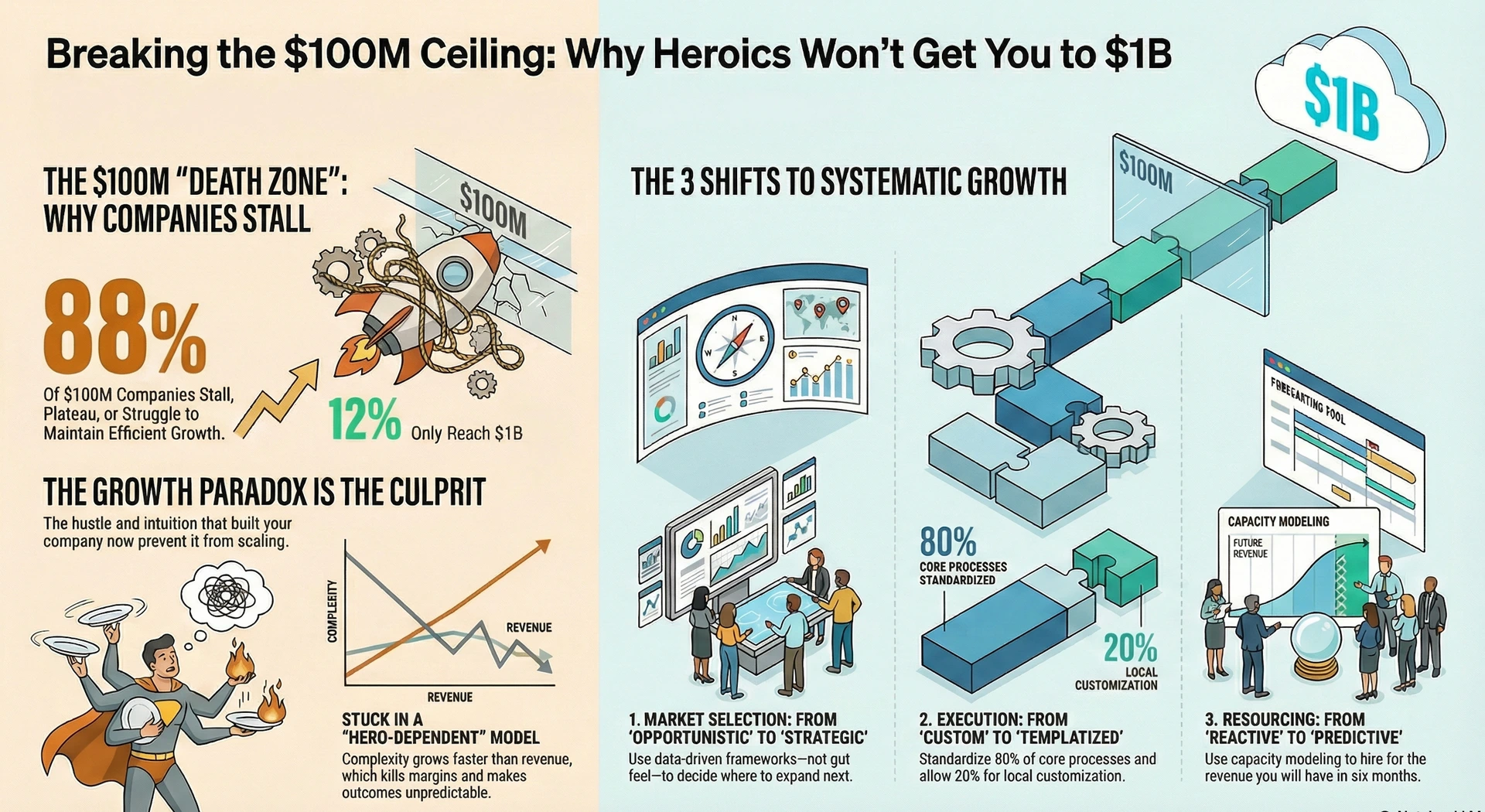
There is a statistic that keeps many mid-market CEOs awake at night. According to McKinsey’s “Grow Fast or Die Slow” study, of the software and services companies that successfully reach $100 million in revenue, only about 12% ever successfully scale to $1 billion.
The vast majority—88%—stall, plateau, or struggle to maintain efficient growth.
Why is this “death zone” so common? It’s not because these companies lack a great product; they’ve already proven product-market fit. It’s not because they lack talent; they often have brilliant, hard-working teams.
The problem is the Growth Paradox: The very instincts that drove your initial success—hustle, intuition, and individual heroics—become the exact obstacles that prevent you from scaling further.
At $10M, you can grow on sheer willpower. At $100M, “figuring it out as you go” is a liability. If you want to break through the ceiling, you must make the painful but necessary shift from heroics to systems.
The Trap of “Heroic” Growth
Most mid-market companies are stuck in what we call Stage Two of growth maturity.
In Stage One (Pure Hustle), everything is custom. The CEO personally selects new locations or key accounts. The COO troubleshoots every launch in real-time. Success relies on individual brilliance.
In Stage Two (Patterns), you have documented best practices, but they aren’t consistently followed. You have “playbooks,” but they become shelf-ware—comprehensive documents that nobody actually uses. Regional leaders have autonomy, but they execute differently, meaning outcomes are unpredictable. You are faster than pure heroics, but you are still dependent on “heroic individuals” to save the day when things go wrong.
The danger of staying in Stage Two is that complexity scales faster than revenue. You add headcount to manage the chaos, which kills your margins, yet you still miss targets because you can’t predict outcomes.
To reach $500M or $1B, you must graduate to Stage Three: Systematic Growth. This isn’t about bureaucracy; it’s about building organizational muscle memory so that growth becomes a science, not an art.
3 Shifts to Break the Ceiling
How do you move from Heroics to Systems? It requires three fundamental shifts in how you operate.
1. Shift Market Selection from “Opportunistic” to “Strategic”
In the early days, you expand wherever there is an opportunity—a personal connection, a seemingly good deal, or a hungry prospect. At scale, this creates a fragmented mess.
Systematic companies replace “gut feel” with Data-Driven Frameworks. They rank potential expansion opportunities against consistent criteria: total addressable market (TAM), competitive density, and talent availability.
The Lesson: Stop letting sales enthusiasm drive strategy. If you can’t explain why market #7 is prioritized over market #12 using objective data, you are still operating on heroics.
2. Shift Execution from “Custom” to “Templatized”
Every time you launch a new location, product, or division, does it feel like you are reinventing the wheel?.
Systematic growth relies on the 80/20 Rule of Standardization:
80% Standardized: Core processes, financial models, brand standards, and risk management must be non-negotiable.
20% Customized: Local marketing, specific staffing mixes, and pricing adjustments can flex to meet local reality.
This prevents the “We’re Different Syndrome” where every regional manager claims their market is too unique for a template16. The goal is to embed these templates into the tools your team uses daily—not a static PDF, but a living workflow in your project management software.
3. Shift Resourcing from “Reactive” to “Predictive”
The hallmark of a “heroic” company is panic hiring. You sign the deal, realize you’re understaffed, and scramble to recruit, leading to poor hires and burnout.
Systematic companies use Capacity Modeling. If you know your average ramp-up time and productivity targets, you should know exactly when to trigger a hire based on your sales pipeline.
The Lesson: You should be hiring for the revenue you will have six months from now, not the revenue you booked yesterday.
The Executive Mandate
Crossing the chasm from $100M to $1B requires a different kind of leadership.
For the CEO: You must stop being the “Chief Problem Solver” and start being the “Chief Architect.” Your job is no longer to touch every decision, but to design the frameworks that allow others to make the right decisions.
For the COO: You must stop rewarding firefighting. If a manager pulls an all-nighter to save a launch, don’t celebrate the heroism—ask why the system failed to prevent the crisis.
For the CFO: You must demand predictability. Growth without profitable unit economics is just vanity. Use your data to enforce the discipline of the playbook.
You have proven your model works. You have the customers24. The only thing standing between you and $1B is the discipline to stop relying on heroes and start building the machine.
Is your growth engine sputtering?
We offer a complimentary Growth Readiness Assessment to help mid-market leadership teams evaluate their maturity level. We’ll help you identify where you are stuck between “Heroics” and “Systems” and pinpoint your highest-impact opportunities for templatization.
Contact EDSO Edge at amelia@edso-edge.com